Fixed Wireless vs 5G Home Internet: Better Than Cable?
For years, cable internet has been the go-to choice for households looking for reliable connectivity. However, new technologies are changing the landscape. Fixed wireless and 5G home internet are becoming increasingly popular options, promising fast speeds, easier installation, and greater flexibility.
If you’re wondering whether these newer technologies can truly replace cable internet, you’re not alone. Many homeowners searching for dependable internet access are evaluating their options before committing to a long-term service plan. Understanding how each technology works, where it performs best, and its potential limitations can help you make a smarter decision.
In this guide, we’ll compare fixed wireless and 5G home internet against traditional cable connections to determine whether they’re realistic alternatives for modern households.
Understanding Traditional Cable Internet
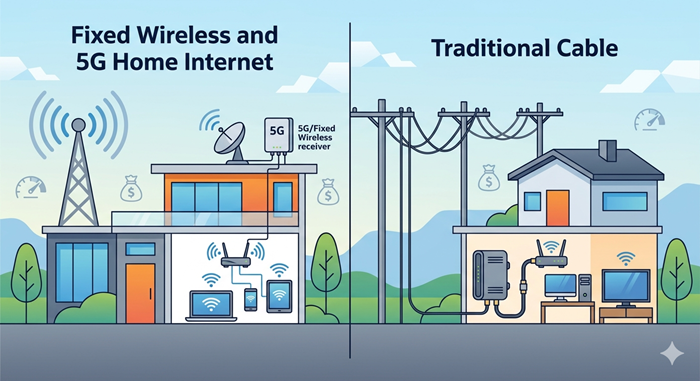
Cable internet delivers broadband service through the same coaxial cable infrastructure used for television services. Because the network is already established in many neighborhoods, cable providers can often deliver high-speed internet without requiring extensive new installations.
Many consumers searching for cable services near me still find cable to be one of the most widely available and dependable internet solutions, particularly in suburban and urban locations.
Benefits of Cable Internet
Cable internet continues to maintain popularity because it offers:
Consistent download speeds
Broad availability
Support for multiple connected devices
Reliable performance during peak usage periods
Bundling opportunities with television and phone services
For households with remote workers, gamers, and streaming enthusiasts, cable often provides a balanced combination of speed and reliability.
What Is Fixed Wireless Internet?
Fixed wireless internet uses radio signals transmitted from a nearby tower directly to a receiver installed at your home. Unlike cable, it doesn’t rely on underground wires or coaxial infrastructure to deliver service.
This technology has become especially valuable in rural and underserved communities where traditional wired broadband may not be readily available.
How Fixed Wireless Works
A service provider installs an antenna or receiver at your property. This receiver communicates with a nearby transmission tower, creating a dedicated internet connection.
Because there is no need to run physical cables to the home, installation can often be completed more quickly than traditional broadband deployments.
Advantages of Fixed Wireless
Fixed wireless offers several appealing benefits:
Faster deployment in remote locations
Reduced infrastructure requirements
Competitive pricing
Availability in areas lacking wired broadband
Simple installation process
For many rural households, fixed wireless represents a significant improvement over slower legacy internet options.
Potential Drawbacks
Despite its advantages, fixed wireless has limitations:
Signal quality can be affected by terrain and obstacles
Weather conditions may impact performance
Availability varies by region
Upload and download speeds may fluctuate
Performance largely depends on proximity to transmission towers and environmental conditions.
What Is 5G Home Internet?
5G home internet uses cellular networks to provide broadband access directly to residential customers. Instead of relying on wired infrastructure, users connect through a wireless gateway that communicates with nearby 5G towers.
As mobile carriers continue expanding their networks, 5G home internet is emerging as one of the most discussed alternatives to traditional broadband.
How 5G Home Internet Works
A 5G modem or gateway installed in your home receives signals from nearby cellular towers and converts them into Wi-Fi access for connected devices.
The setup process is typically straightforward and often does not require professional installation.
Key Benefits of 5G Home Internet
Consumers are attracted to 5G home internet because it offers:
Fast installation
No need for extensive wiring
Competitive pricing
Flexible service plans
Growing nationwide coverage
In many markets, users can activate service within minutes of receiving their equipment.
Fixed Wireless vs Cable Internet
To determine whether fixed wireless can replace cable, it’s important to compare them across several categories.
Speed
Cable internet generally delivers higher maximum speeds than most fixed wireless providers.
While fixed wireless has improved significantly, bandwidth limitations and tower capacity can impact performance during busy periods.
Reliability
Cable networks are generally less susceptible to environmental interference.
Fixed wireless connections may experience disruptions caused by weather, foliage growth, or physical obstructions between the receiver and transmission tower.
Availability
Fixed wireless has a distinct advantage in rural locations where cable infrastructure may not exist.
For customers outside densely populated regions, fixed wireless can often be the only practical high-speed option.
Installation
Fixed wireless typically requires less infrastructure work, making deployment faster and less expensive in many situations.
5G Home Internet vs Cable Internet
The comparison between cable and 5G home internet is becoming increasingly relevant as wireless networks mature.
Performance
Cable internet still tends to offer more consistent speeds, particularly during peak usage periods.
However, in areas with strong 5G coverage, performance can be surprisingly competitive.
Latency
For online gaming and real-time applications, cable generally provides lower and more stable latency.
While 5G continues improving, latency can fluctuate depending on network congestion and signal strength.
Cost
Many consumers find 5G home internet appealing because providers often offer straightforward pricing structures without annual contracts.
This flexibility can make it easier for households to switch services when better options become available.
Equipment and Setup
One major advantage of 5G is simplicity.
Most users can complete installation themselves by plugging in a gateway device and following setup instructions.
When Fixed Wireless Makes the Most Sense
Fixed wireless is often an excellent solution for:
Rural communities
Agricultural properties
Small towns lacking broadband infrastructure
Temporary residences
Areas where cable installation costs are prohibitive
In these scenarios, fixed wireless can deliver substantial improvements over older internet technologies.
When 5G Home Internet Is the Better Choice
5G home internet may be ideal if you:
Live within strong 5G coverage zones
Want a quick setup process
Prefer contract-free service
Need flexibility for future moves
Value simplicity over bundled services
As network expansion continues, coverage and performance are expected to improve further.
Popular Providers Driving Wireless Internet Growth
Several major providers are helping accelerate wireless broadband adoption across the country.
Services such as att fixed wireless have expanded internet access in underserved communities where wired infrastructure remains limited.
Meanwhile, products like verizon 5g home internet and t mobile 5g home internet continue attracting customers seeking alternatives to traditional broadband providers.
Their growing competition is creating more choices and potentially better pricing for consumers.
How to Choose the Right Internet Service
Selecting the best internet option depends on your location, usage habits, and available providers.
Consider Your Household Needs
Ask yourself:
How many devices connect simultaneously?
Do you stream 4K video regularly?
Do you work remotely?
Is online gaming important?
How much speed do you actually need?
Understanding your usage patterns helps narrow your choices.
Compare Available Technologies
If you’re unsure which service type is available at your address, learning about dsl, fiber, or cable can help identify the infrastructure currently serving your home.
Technology availability often influences which internet solutions are realistic options.
Evaluate Emerging Alternatives
Many households considering a move away from traditional television bundles are also exploring alternatives to cable for cheap TV services while reassessing their internet needs.
Separating internet and entertainment services may create opportunities for cost savings.
Compare Cable and 5G Carefully
Before switching, it’s worth reviewing the differences between cable internet vs 5g home internet to understand how performance, reliability, and pricing vary in your specific market.
A side-by-side comparison often reveals which service aligns best with your household’s priorities.
Can Fixed Wireless or 5G Truly Replace Cable?
The answer depends largely on where you live and how you use the internet.
For many urban and suburban households, cable still delivers the most consistent performance and highest reliability. However, wireless technologies have advanced dramatically in recent years.
Fixed wireless offers a practical solution for rural communities where wired infrastructure is limited. Meanwhile, 5G broadband is becoming a strong contender in areas with robust network coverage.
As wireless networks continue expanding and improving, the gap between cable and wireless internet services will likely continue to narrow.
Conclusion
Fixed wireless and 5G broadband are no longer niche technologies. They have evolved into legitimate internet solutions capable of meeting the needs of many households.
Cable remains a strong choice due to its reliability, speed consistency, and widespread availability. However, for consumers seeking flexibility, faster deployment, or service in underserved regions, wireless alternatives are increasingly viable.
The best approach is to evaluate available providers, compare speeds and pricing, and choose the technology that aligns with your household’s specific requirements. As competition increases, consumers ultimately benefit from having more internet and cable services options than ever before.
FAQs
1. Is fixed wireless internet faster than cable?
Usually no, cable generally offers higher and more consistent speeds.
2. Does 5G home internet require a phone plan?
Not always, many providers offer standalone home internet plans.
3. Is fixed wireless good for remote work?
Yes, if signal strength and provider performance are reliable.
4. Can weather affect fixed wireless internet?
Yes, severe weather and physical obstructions can impact performance.
5. Is 5G home internet available everywhere?
No, availability depends on local 5G network coverage.
Related Posts
 Regulations
Technology
Regulations
Technology
What Is Powerline Internet? Everything You Need to Know
Learn what Powerline Internet is, how it works, its pros and cons, speed, setup, and whether it’s the best solution for extending reliable internet at home.
 Broadband Deals
cheap internet plans
Broadband Deals
cheap internet plans
Spectrum Internet Cost After 12 Months Explained
Learn how much Spectrum Internet costs after promotional pricing ends. Discover standard rates, billing factors, and ways to reduce monthly costs.
 Internet Bundles
Broadband Deals
Internet Bundles
Broadband Deals
Best Rural Internet Providers to Keep You Connected in 2026
Discover the best rural internet providers in 2026. Compare Xfinity, CenturyLink, and Viasat by speed, pricing, reliability, and coverage.
 Broadband Deals
cheap internet deals
cheap internet plans
Broadband Deals
cheap internet deals
cheap internet plans
Portland ISP Providers: How to Find the Best Internet Service
Compare Portland ISP providers, internet speeds, pricing, and availability. Learn how to choose the best internet service for your home or business.
 Internet Bundles
AT&T Business Internet: Plans, Speeds & Benefits Explained
Learn everything about AT&T Business Internet, including plans, speeds, fiber availability, pricing, features, equipment, and how to choose the best option.